
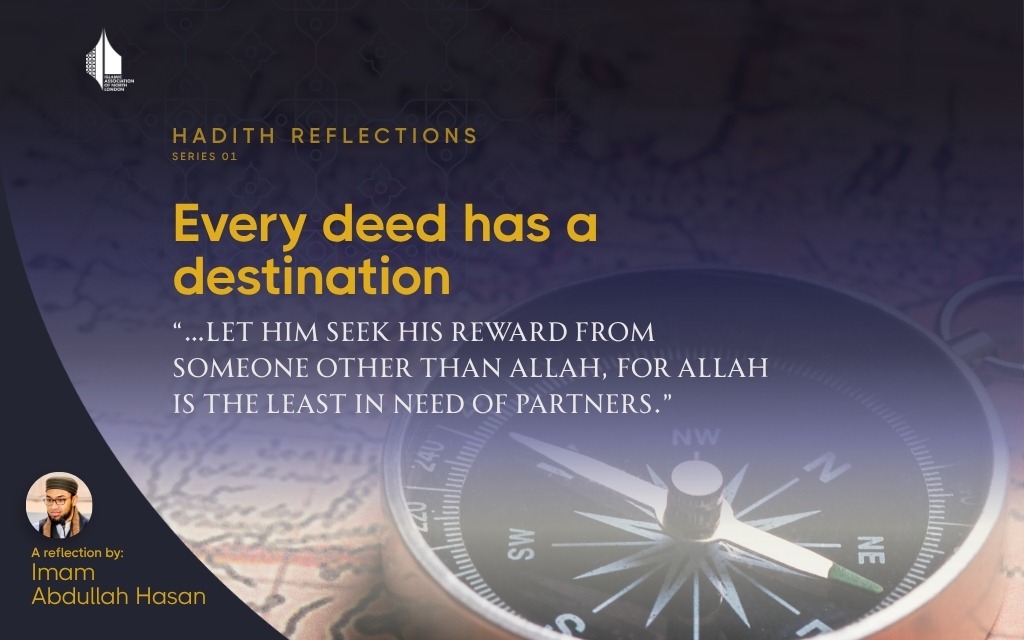
A reflection by Imam Abdullah Hasan, Finchley Mosque.
عَنْ أَبِي سَعْدٍ بْنِ أَبِي فَضَالَةَ الْأَنْصَارِيِّ رضي الله عنه، وَكَانَ مِنَ الصَّحَابَةِ، قَالَ: سَمِعْتُ رَسُولَ اللَّهِ ﷺ يَقُولُ:
«إِذَا جَمَعَ اللَّهُ الْأَوَّلِينَ وَالْآخِرِينَ لِيَوْمٍ لَا رَيْبَ فِيهِ، نَادَى مُنَادٍ: مَنْ كَانَ أَشْرَكَ فِي عَمَلٍ عَمِلَهُ لِلَّهِ أَحَدًا، فَلْيَطْلُبْ ثَوَابَهُ مِنْ عِنْدِ غَيْرِ اللَّهِ، فَإِنَّ اللَّهَ أَغْنَى الشُّرَكَاءِ عَنِ الشِّرْكِ»
Abu Saʿd ibn Abi Fadālah al-Anṣārī رضي الله عنه, one of the Companions, reported that he heard the Messenger of Allah ﷺ say:
“When Allah gathers the first and the last on a Day about which there is no doubt, a caller will proclaim: ‘Whoever associated anyone with Allah in a deed that he performed for Allah, let him seek his reward from someone other than Allah, for Allah is the least in need of partners.’”
Source
Jamiʿ al-Tirmidhi, 3154; Sunan Ibn Majah, 4203; Musnad Ahmad, 15838.
There is a variation in the identification of the Companion in the transmitted sources. The more widely established form is Abu Saʿd ibn Abi Fadālah al-Anṣārī. Some sources give Abu Saʿīd ibn Faḍālah ibn Abi Faḍālah. The biographical sources explain that these refer to the same Companion, and that the name Abu Saʿd is regarded as the more accurate form. (Sunnah.com)
The central expression in the Hadith is:
مَنْ كَانَ أَشْرَكَ فِي عَمَلٍ عَمِلَهُ لِلَّهِ أَحَدًا
“Whoever associated anyone with Allah in a deed that he performed for Allah.”
The wording is significant. The deed is described as something done for Allah, but another has been introduced into it. The warning therefore concerns the integrity of the deed’s intended recipient.
The final statement is especially powerful:
فَإِنَّ اللَّهَ أَغْنَى الشُّرَكَاءِ عَنِ الشِّرْكِ
“For Allah is the least in need of partners.”
Allah is completely free of any need for partnership. He does not need another to share in what belongs to Him.
The Hadith is recorded by al-Tirmidhi, Ibn Majah and Ahmad. Al-Tirmidhi described it as gharīb, noting that he did not know it through this route except from Muhammad ibn Bakr. (dorar.net)
What Does the Hadith Mean?
The Hadith presents a stark image of the Day of Resurrection.
A deed that appeared to belong to Allah may be examined according to the intention with which it was performed. If someone deliberately associated another with Allah in that deed, the announcement will be made: “Seek your reward from someone other than Allah.”
The statement is not suggesting that anyone besides Allah possesses the power to reward in the way Allah rewards. Rather, it exposes the absurdity of seeking two different destinations from one act of worship.
If the deed was performed for Allah and for the admiration of people, then the person cannot expect the deed to be treated as though it had been offered to Allah alone.
The Hadith therefore brings the matter of riyāʾ to its most fundamental point: a deed of worship cannot have two competing ultimate purposes.
Lessons and Takeaways
- A deed has a destination. It is worth asking not only what we are doing, but what we ultimately hope to receive through it.
- Competing motives deserve honest examination. Human motivation can be complex, and recognising that complexity is not the same as declaring oneself insincere. It gives us an opportunity to bring our priorities into greater alignment.
- Immediate recognition can compete with unseen reward. Praise, status and approval are available now, while the reward of Allah requires faith in what lies beyond this life. Sincerity means learning to value the latter above the former.
- Sometimes sincerity requires allowing someone else to receive the credit. Being able to let good work stand without attaching our name to it can reveal whether recognition has become too important to us.
- Our public reputation and our reality before Allah are not necessarily the same. A person can carefully construct an admirable image while the true state of the heart remains known only to Allah.
- The goal is not to eliminate every human desire for appreciation. Rather, appreciation should remain secondary to the reason for which the deed was performed.
- The question of reward can reveal the deeper motive. When we ask, “What reward am I really seeking from this?”, we may discover what has quietly become important to us.
Join the daily hadith lesson
The hadith lesson takes place every day after Dhuhr at Finchley Mosque, 683–685 High Road, North Finchley, London N12 0DA. Everyone is welcome – come along, listen and reflect with us.
More reflections coming soon, insha’Allah.
Found this beneficial? Share it with family and friends – and follow us @finchleymosque for each new reflection.
