
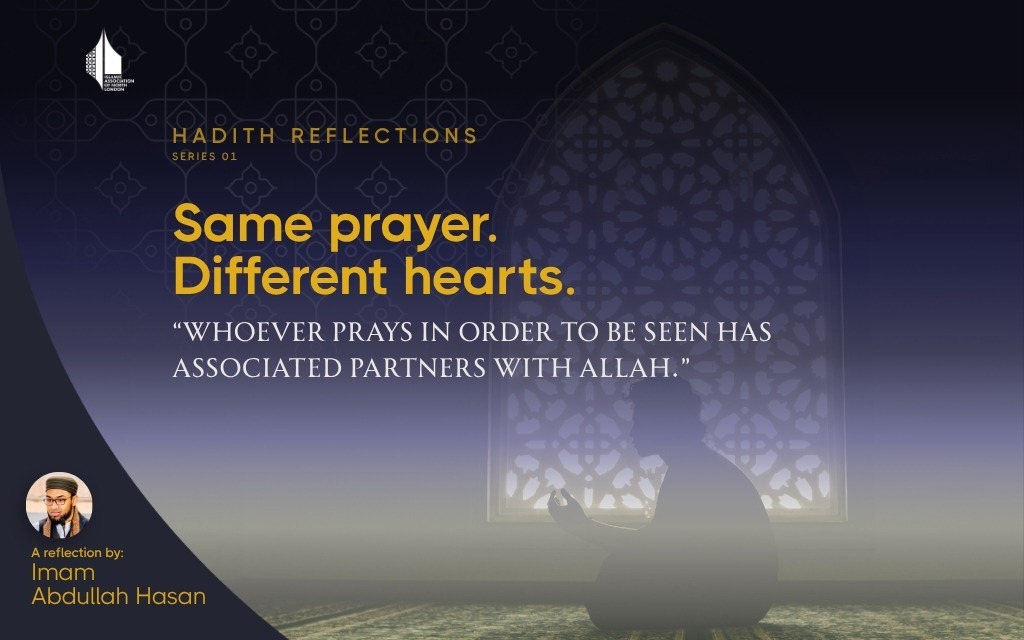
A reflection by Imam Abdullah Hasan, Finchley Mosque.
عَنْ شَدَّادِ بْنِ أَوْسٍ رضي الله عنه، قَالَ: قَالَ رَسُولُ اللَّهِ ﷺ:
«مَنْ صَلَّى يُرَائِي فَقَدْ أَشْرَكَ، وَمَنْ صَامَ يُرَائِي فَقَدْ أَشْرَكَ»
Shaddad ibn Aws رضي الله عنه reported that the Messenger of Allah ﷺ said:
“Whoever prays in order to be seen has associated partners with Allah, and whoever fasts in order to be seen has associated partners with Allah.”
Reported from Shaddad ibn Aws رضي الله عنه.
This Hadith continues the Prophet’s ﷺ warning against riyāʾ (الرِّيَاء), showing off one’s worship in order to be seen, admired or praised by people.
The key word is يُرَائِي (yurāʾī), from the root connected with seeing. It refers to performing an act so that others will see it and form a favourable impression of the person performing it.
The Hadith mentions prayer and fasting, two acts of worship that are fundamentally directed towards Allah. When such worship is deliberately performed for the gaze and approval of people, the intention has become corrupted by directing something that belongs to Allah towards another purpose.
The expression فَقَدْ أَشْرَكَ — “he has associated partners” — is deliberately severe. Riyāʾ has been described by the scholars as a form of minor shirk when a person performs an act of worship for other than Allah, while the person remains within Islam. It is nevertheless a grave matter because worship is an act that should be sincerely devoted to Allah alone.
This should not be understood to mean that every passing desire to be noticed, every feeling of pleasure when someone praises us, or every public act of worship is automatically riyāʾ. The issue is the intention attached to the worship.
A person may begin an act sincerely and later experience thoughts about how others perceive them. The believer’s task is not to abandon the worship in fear, but to correct the intention and turn the heart back towards Allah.
Nor should a person deliberately hide every act of worship. Some acts must be performed publicly, and visible worship can sometimes encourage others towards goodness. The essential question is whether the worship is being offered to Allah or whether the approval of people has become part of its intended purpose.
What Does the Hadith Mean?
The Hadith teaches that worship belongs to Allah alone. Prayer and fasting are not performances through which a person establishes a religious reputation. They are acts of devotion through which the servant turns towards his Lord.
When a person prays because he wants Allah’s pleasure, the worship is directed towards Allah. But when he deliberately prays so that people will see him as pious, his intention has introduced another audience into an act that should belong to Allah alone.
This is why riyāʾ is so dangerous. The outward action may look identical. Two people may stand in exactly the same prayer, recite the same verses and make the same movements, while what lies within their hearts is completely different.
One is worshipping Allah.
The other is performing an image of worship for people.
The Hadith therefore brings the believer back to the question of intention. Who am I trying to please through this act?
Lessons and Takeaways
- Worship is for Allah alone. Prayer, fasting and other acts of worship should not be turned into means of obtaining admiration or status among people.
- The same outward action can have very different meanings depending upon intention. We cannot reliably judge the spiritual value of an act simply by looking at what another person does.
- Riyāʾ is a serious spiritual danger, but it should not become an excuse for abandoning good deeds. When a person notices an unhealthy desire to be seen, the response is to correct the intention and continue striving towards Allah.
- Not every public act is showing off. Worship may sometimes be performed publicly for sound and legitimate reasons. Visibility itself is not the problem; seeking people’s admiration through the worship is.
- Appreciating praise is different from worshipping for praise. A person may naturally feel pleased when appreciated without having made appreciation the purpose of the deed.
- Private worship can help strengthen sincerity. Keeping some acts of goodness between oneself and Allah can protect the heart from becoming dependent upon an audience.
- Comparison can quietly turn worship into performance. When we become preoccupied with how our worship appears beside that of others, our attention can move away from the One whom we are actually worshipping.
- When you notice your intention drifting, return rather than despair. Sincerity is something the believer continually works to protect. The discovery of an unhealthy motive can become an opportunity for correction rather than a reason to give up.
Join the daily hadith lesson
The hadith lesson takes place every day after Dhuhr at Finchley Mosque, 683–685 High Road, North Finchley, London N12 0DA. Everyone is welcome – come along, listen and reflect with us.
Next week: Hadith Reflection 8 – When No One Sees, Yet Someone Is Watching.
Found this beneficial? Share it with family and friends – and follow us @finchleymosque for each new reflection.
