
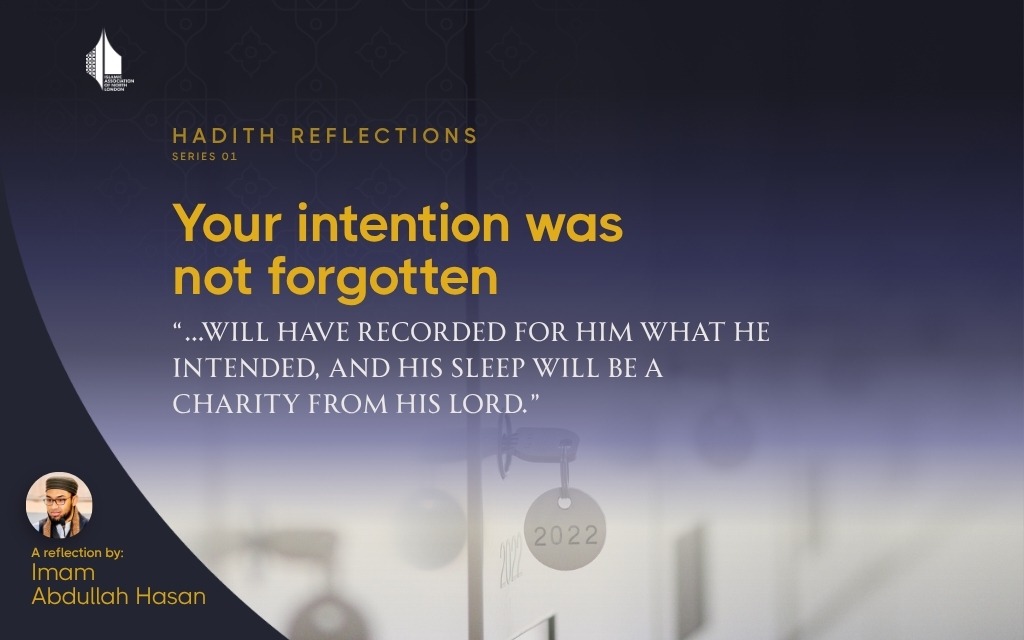
A reflection by Imam Abdullah Hasan, Finchley Mosque.
عن أبي الدرداء رضي الله عنه، قال: قال رسول الله صلى الله عليه وسلم:
«مَنْ أَتَى فِرَاشَهُ وَهُوَ يَنْوِي أَنْ يَقُومَ يُصَلِّيَ مِنَ اللَّيْلِ، فَغَلَبَتْهُ عَيْنَاهُ حَتَّى أَصْبَحَ، كُتِبَ لَهُ مَا نَوَى، وَكَانَ نَوْمُهُ صَدَقَةً عَلَيْهِ مِنْ رَبِّهِ عَزَّ وَجَلَّ»
Abū al-Dardāʾ رضي الله عنه reported that the Messenger of Allah ﷺ said:
“Whoever goes to bed intending to rise during the night to pray, but sleep overcomes him until morning, will have recorded for him what he intended, and his sleep will be a charity from his Lord, the Almighty.”
Source: Sunan al-Nasāʾī, 1787; Sunan Ibn Mājah, 1344.
The importance of sincere intention
The Hadith begins with a person going to bed while intending to rise during the night and pray.
The Arabic expression:
وَهُوَ يَنْوِي
“while intending”
draws attention to what is taking place within the person before anything outward happens.
The person has made a genuine intention to worship Allah. They have decided that they want to leave their sleep and stand before their Lord.
The intended action has not yet happened, but the intention itself is known to Allah.
This is consistent with the wider principle found throughout the Sunnah that intentions have a profound place in the value of our actions.
“Sleep overcame him”
The Hadith then says:
فَغَلَبَتْهُ عَيْنَاهُ
“His eyes overcame him.”
The expression presents sleep as something that overtook the person.
He intended to wake.
He did not.
The distinction matters.
The Hadith is not describing someone who simply decided that night prayer was not worth doing. It describes someone who intended the worship but was overcome by sleep.
This is an important reminder that human beings have limitations. We can intend something sincerely and still be unable to carry it out.
“Until morning”
The person does not wake after a short period.
He sleeps until morning.
From a human perspective, it might seem that the entire intention has been lost. The person may wake and think:
I intended to pray, but I did nothing.
Yet Allah’s judgement is different.
The Hadith says:
كُتِبَ لَهُ مَا نَوَى
“His intention is recorded for him.”
The intended good has not disappeared simply because the person was unable to perform it.
Allah knows what the servant intended
This is one of the most comforting aspects of the Hadith.
People can only see what happens outwardly.
Allah knows what lies within.
Someone may look at another person and see that they slept through the night. Allah knows that the person went to bed sincerely intending to stand and pray.
This distinction between outward outcome and inward intention is important throughout the believer’s life.
Sometimes a person appears unsuccessful while Allah knows the sincerity of their effort.
Sometimes a deed appears impressive while its underlying intention is very different.
The believer therefore learns not to judge everything solely by outward results.
“His sleep is a charity from his Lord”
The final phrase is particularly beautiful:
وَكَانَ نَوْمُهُ صَدَقَةً عَلَيْهِ مِنْ رَبِّهِ عَزَّ وَجَلَّ
“And his sleep was a charity from his Lord upon him.”
The very thing that prevented the intended act of worship becomes, by Allah’s generosity, something beneficial for the servant.
This does not mean that sleep is always preferable to prayer or that a person should stop making an effort to rise for night prayer.
Rather, it shows the generosity of Allah towards someone whose sincere intention was overtaken by a genuine human limitation.
The servant intended good.
The servant was unable to complete it.
Allah did not allow that sincere intention to become worthless.
Lessons and Takeaways
- A sincere intention towards worship has value. Allah knows what you genuinely intended even when the action does not take place.
- Human limitation should not automatically become self-condemnation. Being overcome by genuine physical limitation is different from deliberately abandoning an act of worship.
- Take reasonable steps towards what you intend. Sincere intention is accompanied by effort, preparation and reliance upon Allah.
- Separate effort from outcome. You are responsible for the choices and effort within your ability, but not every outcome is under your control.
- Learn from setbacks rather than turning them into identities. A missed opportunity can become something to learn from rather than evidence that you can never change.
- Look for exceptions and strengths. Notice the occasions when you have succeeded and consider what helped you succeed then.
- Make the next step realistic. Sustainable change often begins with a manageable action rather than an overwhelming demand for immediate transformation.
- Ask what is within your control. Preparation, intention and effort are within your sphere of responsibility; the final outcome belongs to Allah.
- Do not abandon a good intention because of one setback. You can renew your intention and begin again.
- Trust in Allah’s generosity. What looks to you like an unsuccessful night may contain reward and mercy that you cannot see
Admonitions
Warning Against Showing Off
Join the daily hadith lesson
The hadith lesson takes place every day after Dhuhr at Finchley Mosque, 683–685 High Road, North Finchley, London N12 0DA. Everyone is welcome – come along, listen and reflect with us.
Next week: Hadith Reflection 6 – When Praise Becomes the Purpose.
Found this beneficial? Share it with family and friends – and follow us @finchleymosque for each new reflection.
