
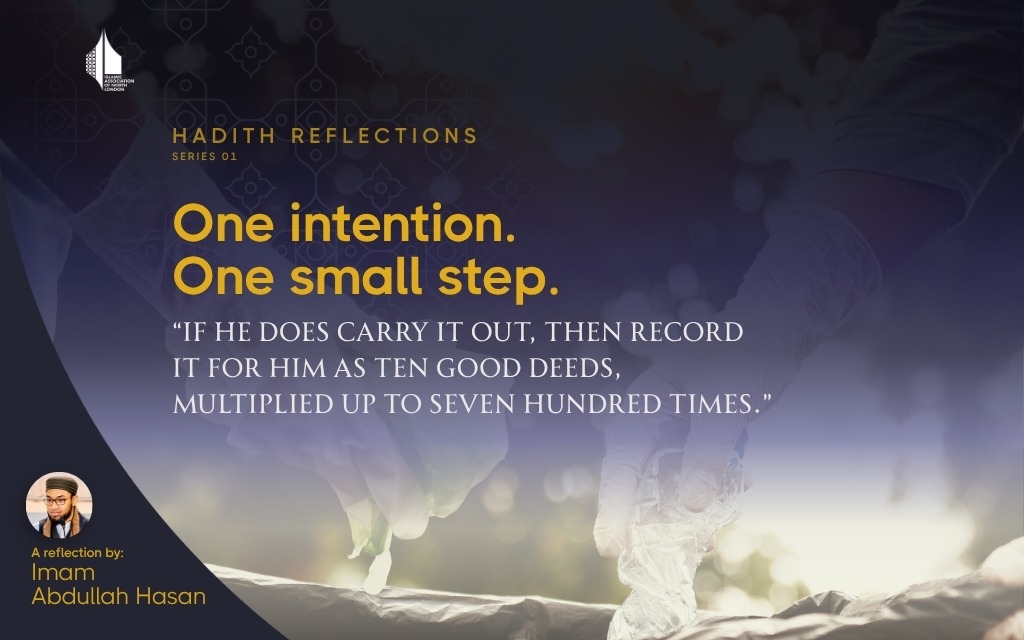
A reflection by Imam Abdullah Hasan, Finchley Mosque.
قال الله عز وجل:
«وَإِذَا أَرَادَ أَنْ يَعْمَلَ حَسَنَةً فَلَمْ يَعْمَلْهَا فَاكْتُبُوهَا لَهُ حَسَنَةً، فَإِنْ عَمِلَهَا فَاكْتُبُوهَا لَهُ بِعَشْرِ أَمْثَالِهَا إِلَى سَبْعِمِائَةِ ضِعْفٍ»
Allah says:
“If he intends to do a good deed but does not carry it out, record it for him as a good deed. If he does carry it out, then record it for him as ten good deeds, multiplied up to seven hundred times.”
Source: Sahih al-Bukhari, 7501.
Allah values the intention towards good
The Arabic begins:
وَإِذَا أَرَادَ أَنْ يَعْمَلَ حَسَنَةً
“And when he intends to do a good deed…”
The word أَرَادَ (arāda) conveys wanting or intending to do something. The person has turned towards the good and genuinely desires to carry it out.
This is important because Islam does not only look at what becomes visible on the outside. The direction of the heart matters.
A person may intend to help someone, give charity, visit a relative, learn something beneficial, reconcile with another person, pray an additional prayer, or make some other positive change. Even before the deed becomes visible, Allah knows that intention.
A good intention is not wasted
Allah then says:
فَلَمْ يَعْمَلْهَا فَاكْتُبُوهَا لَهُ حَسَنَةً
“But if he does not do it, record it for him as a good deed.”
This is a remarkable expression of mercy.
Sometimes a person genuinely intends to do something good but circumstances prevent it. The opportunity disappears. Someone else acts first. The person becomes unable to complete what they intended. Their circumstances change.
Allah knows the difference between an empty wish and a sincere intention.
The Hadith therefore gives hope to the believer: a good intention does not become meaningless simply because the intended action did not happen.
But intention can also become a doorway to action
The Hadith does not stop at intention.
It continues:
فَإِنْ عَمِلَهَا
“If he does it…”
There is something beautiful in this progression.
First comes the intention. Then comes the deed.
A person thinks, I should do this.
Then the next question becomes:
What can I do about it?
This is where spiritual growth becomes practical. A person does not have to transform their entire life in one dramatic moment. Often, the most meaningful change begins with one clear intention followed by one manageable action.
Someone who wants to become more generous might begin with one act of charity. Someone who wants to repair a relationship might begin with one sincere message. Someone who wants to strengthen their prayer might begin by protecting one prayer time more carefully.
The intention gives direction. The action gives it form.
Allah multiplies the reward
Allah says that when the good deed is carried out, it is recorded:
بِعَشْرِ أَمْثَالِهَا إِلَى سَبْعِمِائَةِ ضِعْفٍ
“As ten times its like, up to seven hundred times.”
The contrast is striking.
A good intention is already valued.
A completed good deed is then rewarded generously.
This reveals something about Allah’s generosity: the servant does not have to earn Allah’s favour through enormous achievements before their efforts become meaningful. Even a sincere turning towards good has value, and when that intention becomes action, Allah may multiply its reward far beyond what the servant could have imagined.
Lessons and Takeaways
- A sincere intention towards good has value. Do not dismiss a good intention simply because circumstances prevented you from completing it.
- Do not confuse an unfinished deed with a worthless intention. Allah knows what you genuinely wanted to do and why it remained incomplete.
- When you can act, take the next step. A sincere intention is precious, but when an opportunity for good is available, turn intention into action.
- Make the next step manageable. You do not always need to solve the whole problem at once. Begin with the good that is realistically within your reach.
- Do not let one failure become an identity. Failing to complete something good does not mean you are incapable of becoming better.
- Ask constructive questions. Instead of repeatedly asking, “Why am I like this?”, ask, “What can I do differently next time?”
- Look for the choice that remains. Even when circumstances cannot be controlled, there may still be a small good decision available to you.
- Good intentions can become habits of goodness. Repeatedly turning towards good can gradually influence the direction of a person’s life.
- Do not underestimate small deeds. A deed may look insignificant to you while being immensely valuable in the sight of Allah.
- Let hope lead to action. Allah’s generosity should not make us passive; it should encourage us to keep turning towards what is good.
Join the daily hadith lesson
The hadith lesson takes place every day after Dhuhr at Finchley Mosque, 683–685 High Road, North Finchley, London N12 0DA. Everyone is welcome – come along, listen and reflect with us.
Next week: Hadith Reflection 5 – The Intention That Was Not Forgotten.
Found this beneficial? Share it with family and friends – and follow us @finchleymosque for each new reflection.
